Winter tires lose some of their studs over time - especially after several seasons of use. This immediately affects handling and braking distance on ice and packed snow. One way to extend the life of such tires is to restud, that is, to restore the lost studs. The procedure looks tempting: it is cheaper than new tires and restores the previous grip. However, in practice, everything is not so clear.
What is restudding and how it works
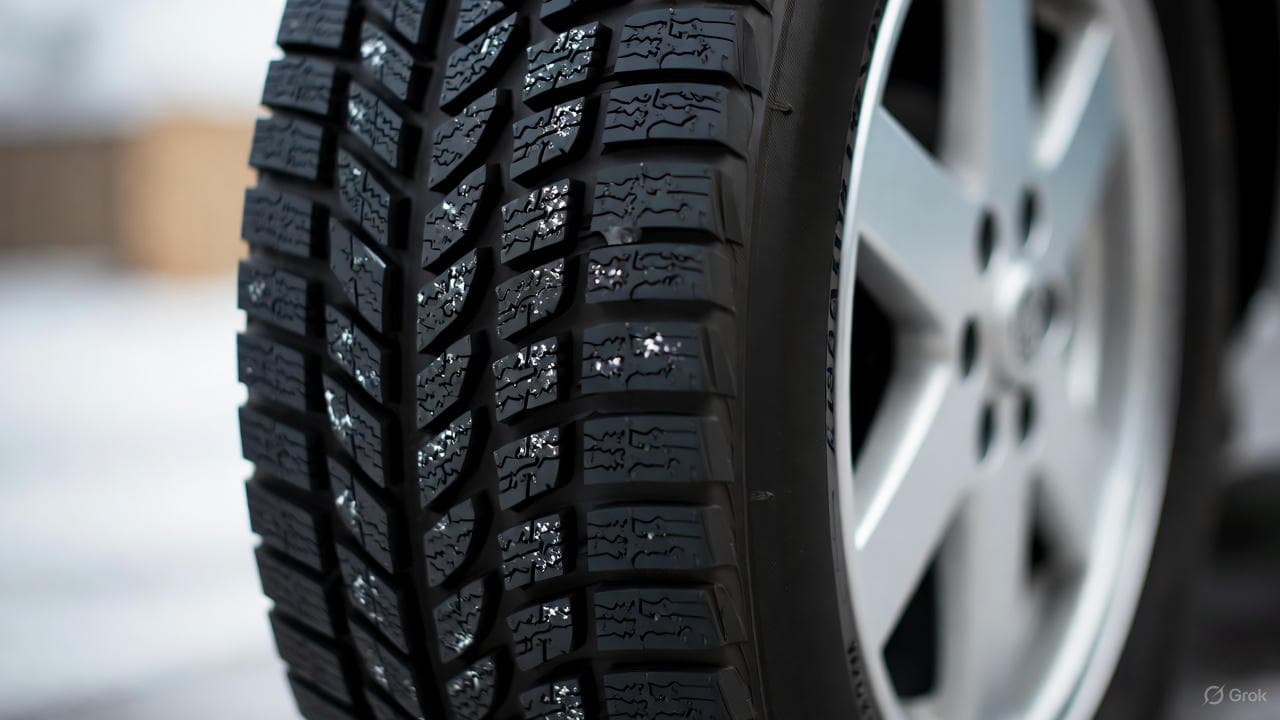
Restudding is the installation of repair studs in place of fallen ones. For this, special mounting holes in the tread are used, which are cleaned and filled with studs of a certain type. It is important that the condition of the rubber allows you to safely perform the procedure - if the tire is old, cracked or worn by more than a quarter, the repair loses its meaning.
Advantages of the method
The main advantage is saving money. Restudding costs several times less than buying a new set of tires, especially if the tread is still deep. In addition, restored tires grip the road better on ice and packed snow compared to "bald" tires, where most of the studs are lost.
Another advantage is the ability to extend the life of the set for one or two seasons. For careful drivers who do not abuse speed and avoid dry asphalt, this can be a real saving.
Disadvantages and pitfalls
However, there are many disadvantages to restudding. Firstly, it is not suitable for all tire models - a lot depends on the structure of the tread and the presence of mounting holes. Secondly, even with high-quality work, repair studs hold worse than factory ones: they can fall out or shift faster, worsening wheel balance.
Another risk is damage to the cord and inner layers of the tire during careless installation. In this case, the restoration will result in additional costs or even tire replacement.
In addition, manufacturers are not responsible for the safety of operation after interference with the design, so you can forget about the warranty.
Expert opinion
Roman Timashov, Director of After-Sales Service at AVTODOM Altufyevo, emphasizes that restudding makes sense only with minimal wear.
The procedure is performed if no more than 10-20% of the studs are lost, and the tread wear does not exceed 25%. The method is really effective, but the result strongly depends on the skill of the specialist and the quality of the studs installed. It is almost impossible to achieve the factory level of fixation.
He also added that restudding helps restore grip and eliminate imbalance, but is a temporary solution.
Is it possible to restud yourself
There are kits for self-restudding, but experts do not advise performing the procedure in garage conditions. Without a professional tool, it is difficult to maintain the correct installation angle and stud seating depth, which is why it may fly out after the first kilometers of run.
When is restudding justified
Repair makes sense if: the tires are no more than three years old; tread wear does not exceed 25%; no more than 20% of the studs are lost; the tires are originally designed for studs.
In all other cases, the savings are doubtful: the restored tire will not provide the same level of safety as a new one, especially when braking on an icy road.
Read more materials:
- 2004 in the Russian auto industry: production growth, foreign car boom and Lada Kalina
- What will the new generation of BMW 3-Series be like
- The most affordable Chinese crossovers in Russia are named
Комментарии