2026 according to the Eastern calendar will be the Year of the Horse, and interest in this animal is already growing. One of the most popular search queries is: why is car power still expressed in horsepower? Together with Tatyana Andrukhova, Associate Professor at the Department of General and Experimental Physics of Altai State University, we delve into the details.
What is horsepower actually?
Horsepower (hp) is a non-SI unit of power, meaning it is not officially part of the International System of Units. In physics, the basic unit of power is the watt (W). Nevertheless, non-SI units are widely used in engineering and technology - a similar story with calories, popular among chemists.
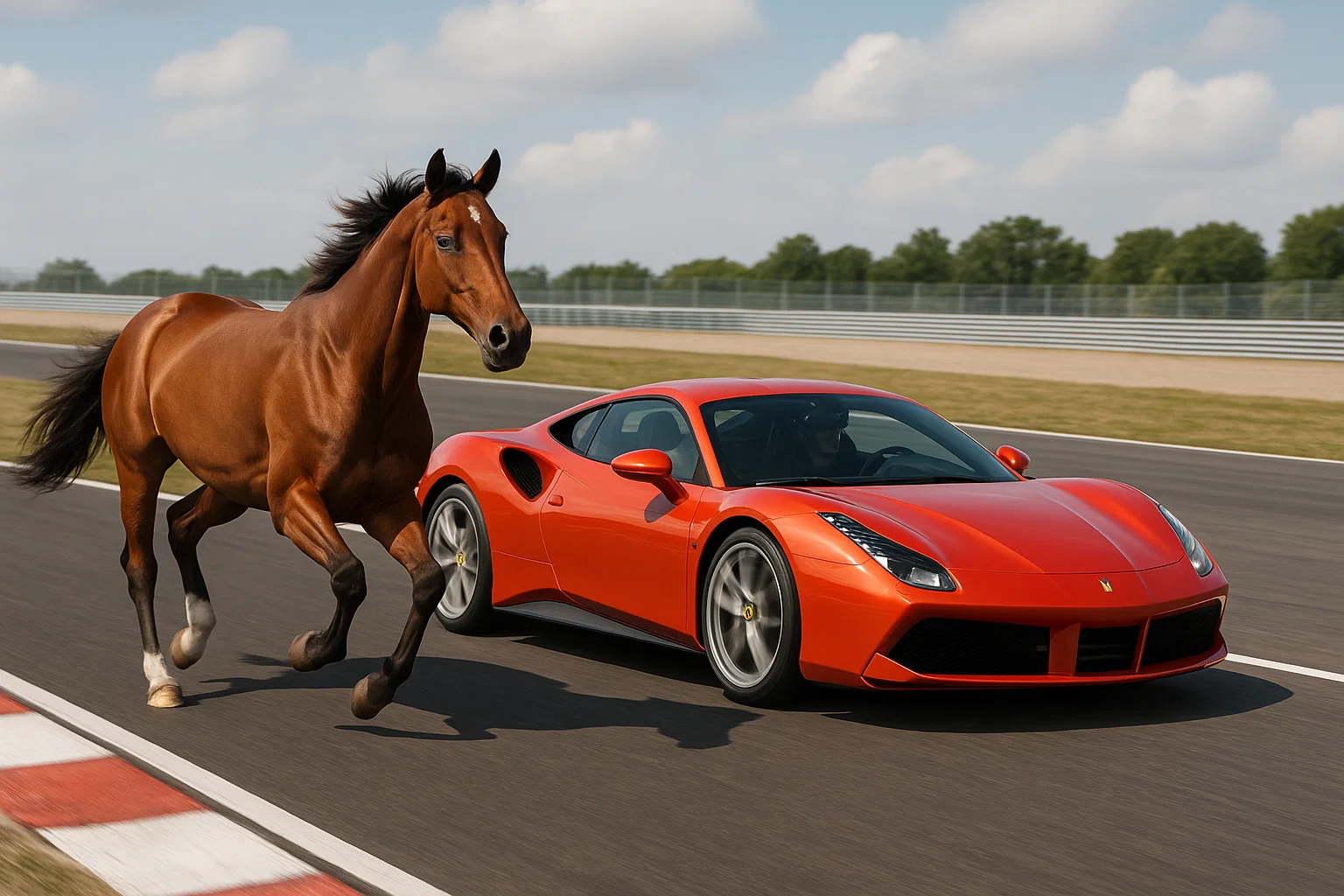
It is important to understand: we are not talking about force as such, but about the amount of work that a mechanism performs per unit of time.
The following formula is most often used for calculation:
hp = (torque × RPM) / 5252
Torque is the thrust created by the engine when the shaft rotates. That is, the torque reflects the force, and horsepower is the torque combined with the speed of rotation.
It is generally accepted that: 1 hp = 735.499 W (in the metric system). Different countries and languages use different notations: hp, PS, CV.
There is also a nuance: in the USA and Britain, mechanical horsepower is a couple of percent larger - 1 hp ≈ 745.7 W.
Why was the horse taken as the unit?
Horses were the main draft transport for millennia - until steam engines and the first trains. Therefore, comparing performance with a horse was obvious to people in the 18th century.
The unit of power was proposed in the 1780s by Scottish engineer and inventor James Watt. To advertise his steam engine, he compared it to the work of a real working horse turning a mill wheel. Watt slightly exaggerated the capabilities of animals - he took a particularly strong horse as a standard. But the marketing worked: business quickly realized the benefit - a steam engine replaces several "horses" at once and does not require feed or treatment.
Later, the unit of power was named after Watt - the watt, but the "horse" remained in the automotive tradition.
And the internal combustion engine, to which horsepower is most often applied today, appeared only in 1876 - it was created by the German Nikolaus Otto.
What types of horsepower exist?
Over time, several variations of this value appeared:
| Type of horsepower | Where it is used | Feature |
|---|---|---|
| British (hp) | USA, Great Britain | Historical Watt formula |
| Water (WHP) | Pumps | Calculated based on water transfer energy |
| Electrical | US Industry | Used for electric motor power |
| Boiler | Steam boilers | Estimates the ability to generate steam |
| Metric (hp) | Europe, Russia | 735.49875 W |
| Tax | Transport tax system | Depends on the geometry of the cylinders |
And how many horsepower... in the horse itself?
If we consider the physiology of a real animal, then on average a healthy horse is capable of developing about 10 horsepower, and in a peak spurt - up to 15. That is, in a car with a 100 hp engine, about 10 real horses are conditionally "working".
For clarity: - UAZ "Patriot" (150 hp at 5000 rpm) can be compared with the effort of approximately 15 powerful horses. The Aurus Senat of the President of Russia with 598 hp plus 40 hp of an electric motor is already about 64 "combat" horse athletes.
Read more materials on the topic:
- Aston Martin Bulldog: the forgotten ancestor of hypercars
- Italjet Dragster 459 Twin: a new level of insane scooter
- BAIC BJ40: how a Chinese SUV with army roots became an alternative to Prado and Tank 300
Комментарии