In the mass-market family crossover segment, the Nissan X-Trail and Haval F7 have garnered special attention. The X-Trail has become a true icon in Russia: since the release of the 32-series model, almost 150,000 cars have been officially sold, not counting those brought in with right-hand drive. The Haval F7, although a newcomer compared to the Japanese car, quickly found its buyer - more than 11,000 cars in the first year of sales and over 20,000 in the following year. Over the years, operating experience has accumulated in the market, which makes comparing the used car market especially relevant for a budget of up to 2 million rubles.
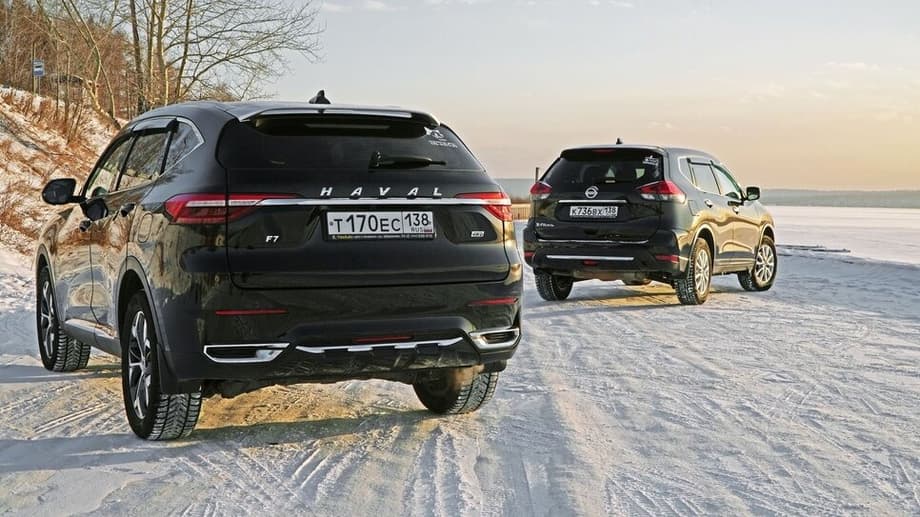
From the point of view of engines and configurations, it is more rational to look at the 2.0-liter versions of both models. The more powerful 2.5-liter X-Trail is less in demand, and owning it is complicated by increased utilization. The Haval F7 of the same volume offers newer models with better dynamics for the same money, which makes it more attractive in the used car market. In addition, the F7 is less often found "on order" and practically eliminates questions with the left-hand drive, which eliminates the traditional risks of parallel imports.
Externally, the cars attract different audiences. The X-Trail looks conservative, while the F7 looks youthful and daring. Even basic versions on 17-inch wheels look compact, but at the same time, the F7 looks fresher and more modern. The inner world of the Japanese car is cozy, like a living room in a house with history: a spacious cabin, high-quality materials, and no annoying squeaks. The Chinese F7 offers a bright front panel facing the driver, a high tunnel, and embossed seats, creating a sporty impression, but the feeling of spaciousness is inferior to the X-Trail.
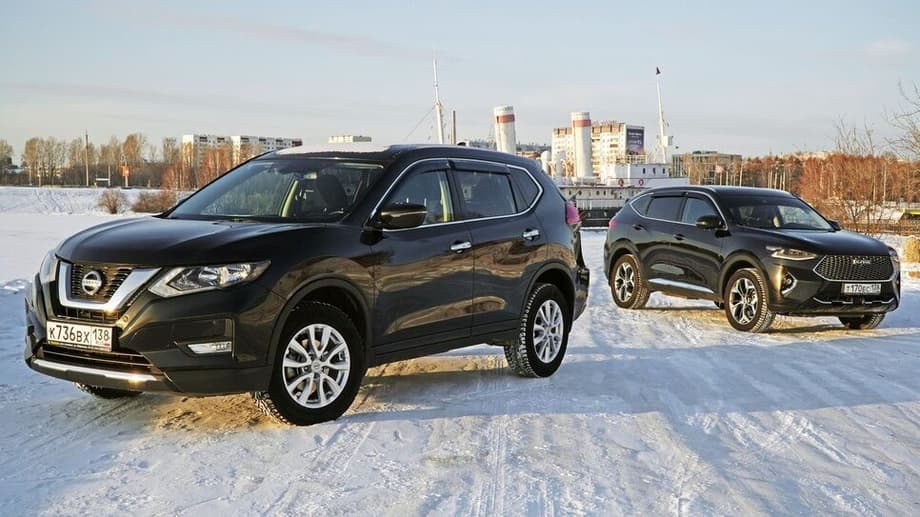
The comfort of the rear row differs between the two crossovers. The X-Trail is limited - there is no heating, charging ports, or major amenities, but the fabric trim saves in winter. The Haval F7 provides more space, is equipped with heating, charging ports, and an armrest, although the location of some elements is inconvenient. The X-Trail's trunk is convenient for transporting long items and has a full-size spare tire, while the F7 wins in terms of volume but lacks a number of small niches and amenities.
On the road, the X-Trail behaves predictably: the Jatco JF016E variator smoothly distributes torque, the suspension is tuned for smooth asphalt, and the MR20DD engine confidently pulls up to the limit speeds without sudden jerks. The F7 is more powerful, the turbocharged 1.5 and 2.0-liter engines provide an increase in power and torque, but the robot gearbox sometimes lags, especially during active acceleration. The F7's suspension is a bit stiff on waves and speed bumps, but it has a margin of safety and can withstand moderately aggressive driving.
As for reliability, the X-Trail has been tested by time: the MR20DD engine, with proper maintenance, lasts up to 200-250 thousand km, the variator, with oil changes every 40-50 thousand km, is capable of going 150-200 thousand km. The F7, although it has been on the market for fewer years, has proven itself well: the GDIT engines are turbocharged, the 2.0-liter has a higher resource than the Japanese, and the robot gearbox is durable and protected by electronics. The main problems are minor transmission parts, reducer oil seals, and consumables, which are not critical for an experienced driver.
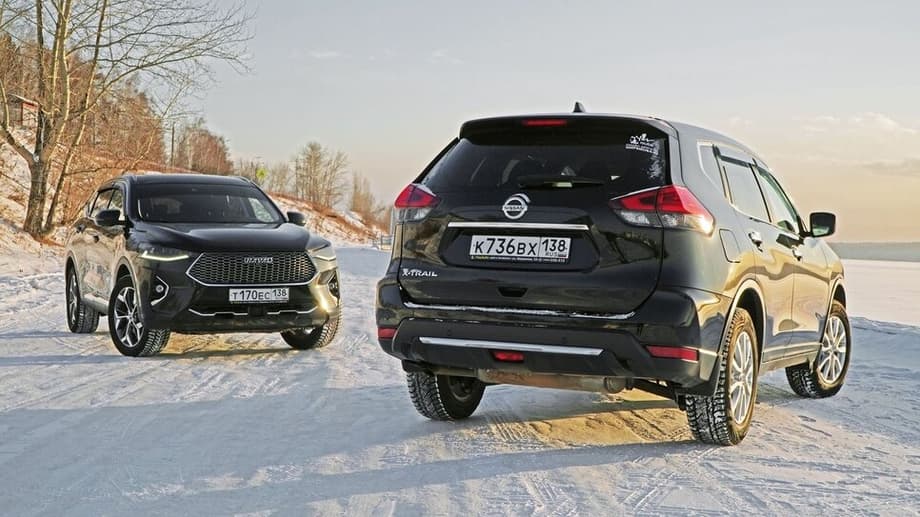
Based on the comparison, the Nissan X-Trail remains the standard of a classic family crossover - reliable and comfortable, but conservative. The Haval F7 wins in dynamics, modernity, and equipment, demonstrating that second-tier Chinese cars are already capable of competing with proven Japanese models in the used car market. The choice between them comes down to priorities: old-fashioned comfort and proven reliability or youthful style and more powerful dynamics.
Read more materials:
Now on home
Net Loss Under RAS Increased 11 Times

Police, Ministry of Emergency Situations, bailiffs and towing services: who has the right to violate the integrity of the car
Price reaches 2.1 million rubles, delivery time - up to 7 months
Prices, Configurations, and Specifications of Models Revealed

Prices for LADA Granta start from 680,000 rubles
Disposable Parts as the New Reality of the Automotive Industry

Two cars of the same era, created for currency export, but with different philosophies

The crisis, compromises, and wrong decisions that buried a promising model


Resident of Sverdlovsk Region Recovers 192,000 Rubles and Receives Compensation

At the end of 2025, the crossover topped the sales ranking of new cars in the capital

The legendary racer moves around in a wheelchair and is under constant medical supervision